(Okayama ~ Kochi) “JR Seto-Ohashi & Dosan Line”, Limited Express “Nampu” in Japan (Rail Track Diagram Map)
投稿日 Posted on
更新日 Updated on
This page is about railway track wiring maps of the JR Seto-Ohashi Line & Dosan Line  from Okayama to Kochi in Japan.

特急「南風」号の走るJR瀬戸大橋線・土讃線の岡山から四国の高知までの線路配線図です。

(Okayama ~ Kochi) Mapas de diagramas de vías Ferrovarias de “JR Seto-Ohashi Line & Dosan Line” en Japón.

這是 JR瀨戶大橋線・土讚線 在日本 従岡山 到高知 的鐵路圖。
Okayama is a large city in the Sanyo region (Chugoku region) with an urban population of over 700,000 people and a metropolitan area population of over 1.6 million people. In addition to being a stop for all Shinkansen trains, there is also  "Super Inaba" that goes to the northeast to Tottori, "Yakumo'' goes to the northwest to Yonago, Matsuyama, and Izumo, "Shiokaze'' goes to Matsuyama in Shikoku, and "Nampu'' goes to Kochi. All limited express trains use a pendulum type train (only the "Shiokaze'' has an air spring tilting body) and can travel 20 km/h faster than regular trains around curves. This page introduces the limited express train "Nampu'' that connects Okayama and Kochi.

The JR Seto-Ohashi Line is a line that connects Okayama Station and Utazu/Sakaide Station in Shikoku. Strictly speaking, trains run on the Uno Line from Okayama to Chayamachi, and the Honshi-Bisan Line from Chayamachi to Utazu/Sakaide.

The section from Okayama to Chayamachi is single track, but due to improvement work, it has been partially converted to double track. Trains run at a maximum speed of 100 km/h in this section.

From Chayamachi to Utazu Station, the train enters the Honshi-Bisan Line, and the train runs at a maximum speed of 130km/h from Chayamachi to Kojima Station, and at a maximum speed of 120km/h from Kojima Station to Utazu Station. After passing Kojima Station, the train crosses the Seto Ohashi Bridge and enters Shikoku Island from Honshu Island.
From Chayamachi to Utazu Station, the train enters the Honshi-Bisan Line, and the train runs at a maximum speed of 130km/h from Chayamachi to Kojima Station, and at a maximum speed of 120km/h from Kojima Station to Utazu Station. After passing Kojima Station, the train crosses the Seto Ohashi Bridge and enters Shikoku Island from Honshu Island.

Once the train enters Shikoku Island, the line branches towards Sakaide and Takamatsu. The rapid train "Marine Liner'' runs from Okayama to Takamatsu.

The section from Utazu to Tadotsu runs on the JR Yosan Line. At Tadotsu Station, the Yosan Line towards Matsuyama branches off, and the limited express "Nampu'' enters the Dosan Line.
Kotohira is a tourist destination famous for a shrine called "Kompira-san", and the approach to the shrine has 1,368 steps. A private railway called "Kotoden" runs parallel to the JR line from Takamatsu to Kotohira, and is in competition with it. The 1500V DC electrified section that runs from Okayama and Takamatsu ends at Kotohira Station, and the section from Kotohira Station towards Kochi is non-electrified.

When the train leaves Kotohira Station, it enters a mountainous area. Tsubojiri Station, located along the way, is a switchback station, and local trains that stop at this station depart and arrive in reverse order.

The JR Tokushima Line from Tokushima joins at Tsukuda Station, and the train arrives at Awa-Ikeda Station, a town upstream of the Yoshino River.
The section from Awa-Ikeda to Tosa-Yamada is an area with many tunnels in the Shikoku Mountains. Kazura Bridge, a suspension bridge located 20 minutes by car from Oboke Station, is a famous sightseeing spot along the line. The limited express "Nampu" runs at a maximum speed of 120km/h on the Dosan Line.
From Tosa-Yamada Station, the train enters Kochi Plain. Many local trains from Kochi return at Tosa-Yamada Station.
At Gomen Station, the Gomen-Nahari line of Tosa Kuroshio Railway, a third sector railway, joins. Most Gomen-Nahari Line trains run from Gomen Station to Kochi Station.
Kochi is a city in the southern part of Shikoku, with a thriving agricultural and fishing industry. A streetcar called "Tosaden'' runs east-west and north-south in the city. Because the JR Dosan Line is not electrified, people in Kochi refer to "Tosaden'' as "Densha(Electric train),'' and refer to JR as "JR,'' "Kisha(Diesel train)", or "Ressha(train)".

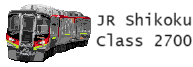
The limited express "Nampu" travels about 180km from Okayama to Kochi in about two and a half hours. JR Shikoku originally planned to use a 2600 series diesel car with an air spring tilting body for this train. However, test runs of the 2600 series revealed that the Dosan Line had many curves and the air tank capacity was insufficient, so plans were changed and a controlled pendulum vehicle called the 2700 series was manufactured.


Leave a Reply