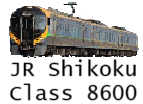

This page is about railway track diagrams(wiring maps) of the JR Yosan Line from Takamatu to Matsuyama in Shikoku Island, Japan.

特急「いしづち」号の走る、JR四国の予讃線の高松から松山までの線路配線図です。

(Takamatsu ~ Matsuyama) Mapas de diagramas de vías Ferrovarias de “JR Shikoku Yosan Line” en Japón.

這是 JR四国・予讚線 在日本 従高松 到松山 的鐵路圖。
| Table of contents 目次 1. Traveling from Takamatsu to Matsuyama: Train or Bus? 高松から松山までの移動、電車と高速バス、どっちが便利? 2. What kind of railway company is JR Shikoku? JR四国とはどんな鉄道会社ですか? 3. What kind of railway line is the JR Yosan Line? JR予讃線とはどんな鉄道路線ですか? |

1. Traveling from Takamatsu to Matsuyama: Train or Bus?
高松から松山までの移動、電車と高速バス、どっちが便利?
In Shikoku Island, Japan, where there is no Shinkansen High speed train, which is more convenient to travel from Takamatsu in Kagawa Prefecture to Matsuyama in Ehime Prefecture, by bus or train?

The answer depends on the case. If you are only going one way and you want to go during the hours when limited express services are in operation, then the express bus is more convenient, but if you are going round trip and want to get there quickly without getting caught in traffic, then the limited express "Ichizuchi" operated by JR Shikoku is more convenient.

The fastest bus from Takamatsu to Matsuyama is the Botchan Express, which runs from Takamatsu to Matsuyama in 2 hours and 25 minutes and is operated by the 2 private bus companies and JR Bus, Shikoku Expressway Bus & Iyotetsu Bus, & JR Shikoku Bus, a subsidiary of JR Shikoku. This bus operates 12 round trips per day, of which only four are limited express bus services that run in 2 hours and 25 minutes, and the rest run in about 2 hours and 50 minutes. The fare is 4,400 yen, and there are various discounts, such as a round trip fare of 4,200 yen for a one-way fare. It is very convenient for passengers to get to Matsuyama-Shi(Matsuyama City) Station in the center of Matsuyama City.

Meanwhile, there are railways in Shikoku, and JR Shikoku operates the limited express "Ishizuchi" on the Yosan Line from Takamatsu to Matsuyama. This train runs 16 round trips a day. The journey takes about 2 hours and 35 minutes, and the total fare (non-reserved seat) is 6,160 yen. A two-journey ticket that allows you to ride in a reserved seat is also available for 8,500 yen (4,250 yen per one-way trip). The limited express trains run more frequently than the  limited express buses.

For detailed information on the Botchan Express buses, please see below↓

JR Shikoku Bus(English)
https://japanbusonline.com/en
Timetable(Japanese)
https://www.jr-shikokubus.co.jp/businfo/bocchan_ex/matsuyama.html
 新幹線がない四国において、香川県の高松から愛媛県の松山までの移動にはバスと鉄道どちらが便利でしょうか。結論から申し上げるとそれはケースバイケースです。片道のみの利用でかつ、速達便が運行されている時間帯であれば高速バスが便利で、往復利用で渋滞に巻き込まれずに早く行きたい場合にはJR四国が運行する特急「いちづち」号が便利です。

 高松から松山までの区間で一番速いのは高松から松山までを2時間25分で走る坊ちゃんエクスプレスという高速バスで、民営の四国高速バスと伊予鉄バス、そしてJR四国の子会社であるJR四国バスにより運行されています。このバスは1日12往復が運転されていますが、このうち2時間25分で走行する特急便は1日4往復に限られ、それ以外の便は所要時間約2時間50分で走行します。運賃は4,400円で、往復すると片道の運賃が4,200円になるなど各種割引もあります。松山市の中心部の松山市駅に乗り入れるのは乗客にとって大変便利です。

 一方、四国においては鉄道も存在し、JR四国が予讃線の高松から松山までの区間において特急「いしづち」号を運行しています。この列車は1日16往復が運行されています。所要時間は約2時間35分で、運賃と自由席特急料金の合計は6,160円です。こちらも指定席に乗車できる2回分の回数券が8,500円(片道あたり4,250円)で発売されています。速達便がバスよりも高頻度で運行されています。

 高速バス 坊ちゃんエクスプレスの詳細な情報に関しては下記をご覧ください↓

JR四国バスホームページ
https://www.jr-shikokubus.co.jp
坊ちゃんエクスプレス時刻表
https://www.jr-shikokubus.co.jp/businfo/bocchan_ex/matsuyama.html

2. What kind of railway company is JR Shikoku?
JR四国とはどんな鉄道会社ですか?
JR Shikoku was established in 1987 with the privatization of Japanese National Railways(JNR), and currently operates the former JNR railway lines within Shikoku Island.

Shikoku has a small population, and since the 1990s, the construction of expressways has progressed and motorization has increased, so almost all of the railway lines, including the Yosan Line connecting Takamatsu to Matsuyama, the Dosan Line connecting Takamatsu to Kochi, and the Kotoku Line connecting Takamatsu to Tokushima, are in the red. Competition with express buses is so fierce that JR Shikoku has established a subsidiary called JR Shikoku Bus to enter the express bus market.

JR Shikoku is characterized by its line network centered on Takamatsu. Before the Seto-Ohashi (Seto Great Bridge) Line was opened, rail ferries ran from Uno on Honshu to Takamatsu on Shikoku, connecting various parts of Honshu to Shikoku via Takamatsu Station. Currently, there are many limited express trains that run to and from Okayama terminal on Honshu, and Takamatsu terminal in Shikoku Island.
 JR四国は1987年の国鉄分割民営化で誕生した会社で、四国内の旧国鉄の鉄道路線の運営を行っている会社です。

 四国ではもともと人口が多くないという点と、1990年代以降で高速道路の建設が進みモータリゼーションが進行したことなどが理由で、高松から松山までを結ぶ予讃線、高松から高知までを結ぶ土讃線、高松から徳島までを結ぶ高徳線を含めほぼすべての路線が赤字になっています。高速バスとの競争が激しく、JR四国自らJR四国バスという子会社を設立し、高速バス事業の市場に参入しています。

 JR四国の特徴は、高松を中心とした路線網を有していることです。瀬戸大橋線が開通する以前は、本州の宇野から四国の高松まで鉄道フェリーが運航されていて、高松駅を介して本州から四国各地を結んでいました。現在では本州の岡山を発着する特急と、高松を発着する特急が多数運行されています。

Unlike the other JR companies in Honshu and Kyushu (JR East, JR Central, JR West, and JR Kyushu), JR Shikoku has not been able to achieve public listing or privatization, just like JR Hokkaido, due to its operating losses. Since its establishment, it has been managed with a subsidy from the government, essentially a management stabilization fund. In order to compete with express buses and private cars, JR Shikoku has renovated stations that had Y-shaped rail track switches from the JNR era, which limited train speeds, into a straight through method  system, and has introduced pendulum-type and air-spring tilting car trains on its express trains to enable faster travel around curves.

The infrastructure is basically owned by JR Shikoku, and freight trains are operated by JR Freight, which pays a track usage fee to JR Shikoku. However, Japan is the exact opposite of the United States and Canada, and rail freight transport is poor. To protect JR Freight, like other JR passenger railway companies, JR Freight pays JR Shikoku only the additional costs required to operate freight trains, which is called the "avoidable cost method". Therefore, profits from rail freight transport do not become profits for JR Shikoku.
 JR四国は本州と九州のJR各社(JR東日本、JR東海、JR西日本、JR九州)とは異なり、赤字経営のためJR北海道と同様に株式の上場、民営化が達成できていません。設立当初から経営安定基金という国からの実質的な補助金を受けて経営が行われています。高速バスやマイカーとの競争のため、JR四国は列車の速度制限を受ける国鉄時代のY字型分岐器のある駅を1線スルー方式に改築し、カーブでも速く走行できるように振り子式、ならびに空気ばね式車体傾斜列車を特急列車に投入しています。

 インフラは基本的にJR四国が保有していて、貨物列車はJR貨物が線路使用料をJR四国に支払うことにより運行されています。但し、日本は米国やカナダとは真逆で鉄道貨物輸送が貧弱で、JR貨物の保護を理由に他のJR旅客鉄道会社と同様、アボイダブルコスト方式という貨物列車を運行するために追加的に係る経費のみをJR貨物がJR四国に支払うルールになっているため、鉄道貨物輸送の利益はJR四国の利益にはなりません。
3. What kind of railway line is the JR Yosan Line?
JR予讃線とはどんな鉄道路線ですか?
The JR Yosan Line is a railway line stretching 327km in length, linking the east and west of Shikoku from Takamatsu to Uwajima via Matsuyama along the Seto Inland Sea. The maximum train speed is 130km/h. The section from Takamatsu to Iyo-shi(Iyo City) Station via Matsuyama is electrified with 1500V DC.

Many trains operate in the Takamatsu area, and the section from Takamatsu Station to Tadotsu Station is double tracked. In addition to limited express and local trains, there are the "Marine Liner" rapid trains, which runs between Takamatsu and Okayama on Honshu at a maximum speed of 130km/h, and the "Sunport" rapid train, which runs from Takamatsu to Kan-on-ji via Sakaide, Utazu, and Tadotsu. The "Marine Liner" rapid train has a double-decker cab car on one side. There are green-reserved seats on second floor and on first floor behind the driver's cab, and 3rd-class-reserved seats on ground floor and on first floor near the second car.

Takamatsu Station is the terminal station of JR Shikoku, and in addition to the Yosan Line, trains on the Kotoku Line, which connects Takamatsu and Tokushima, depart and arrive there. Near Takamatsu Station is Takamatsu Chikko Station, which is operated by the private railway company Kotoden, and Kotoden operates trains on three lines in Takamatsu: the Kotohira Line, the Nagao Line, and the Shido Line.
 JR予讃線は瀬戸内海に沿って高松から松山を経由して宇和島までの四国の東西を結ぶ、全長327kmの鉄道路線です。列車の最高速度は130km/hです。高松から松山経由、伊予市駅までの区間が直流1500Vで電化されています。

 高松のエリアでは多くの列車が運行されていて、高松駅から多度津駅までは複線化されています。特急列車と普通列車の他に高松と本州の岡山を結ぶ最高速度130km/hの快速「マリンライナー」と、高松から坂出、宇多津、多度津を経由して観音寺までを結ぶ快速「サンポート」が運行されています。快速「マリンライナー」は片側の先頭車が2階建てになっていて、2階席と運転室後ろがグリーン車指定席、1階席と2号車寄りの座席が普通車指定席となっています。
 高松駅はJR四国のターミナル駅で、予讃線の他に高松と徳島を結ぶ高徳線の列車が発着します。高松駅の近くには私鉄の「ことでん」の高松築港駅があり、「ことでん」は高松において琴平線、長尾線、志度線の3つの路線に電車を運行しています。

Hashioka Station was renovated in 2002 and has passing loops on both the up and down lines, where many local trains wait for express and rapid trains to pass. The rapid "Sunport" train stops at this station.

The section from Sakaide Station to Utazu Station is a junction with the JR Seto-Ohashi(Seto Great Bridge) Line, where limited express trains from Okayama on Honshu such as Shiokaze (Okayama - Matsuyama), Nanpu (Okayama - Kochi), and Uzushio (Okayama - Takamatsu - Tokushima) enter into the Yosan Line.

Marugame Station is an elevated station in Marugame City, the second largest city in Kagawa Prefecture, which is famous for its udon noodles made by Marugame Seimen. All trains stop here.

Tadotsu Station is the starting point of the JR Dosan Line, where the limited express trains Nanpu (Okayama - Kochi), Shimanto (Takamatsu - Kochi), and some local trains from Takamatsu and Okayama branch off onto the Dosan Line. JR Shikoku's Tadotsu Workship is also located in Tadotsu. From Tadotsu Station onwards, the Yosan Line becomes a single track section.
 端岡駅は2002年に改築された上下線に通過線を有する駅で、多くの普通列車が特急や快速列車の通過待ちを行います。快速「サンポート」はこの駅に停車します。
 坂出駅から宇多津駅までの区間はJR瀬戸大橋線とのジャンクションになっており、本州の岡山方面からの特急「しおかぜ(岡山~松山)」、「南風(岡山~高知)」、「うずしお(岡山~高松~徳島)」が乗り入れます。
 丸亀駅は丸亀製麺のうどんで有名な香川県で2番目に大きな丸亀市にある高架駅で、全ての列車が停車します。
 多度津駅はJR土讃線の起点の駅で、特急「南風(岡山~高知)」、「しまんと(高松~高知)」と一部の高松・岡山方面からの普通列車が土讃線へ分岐します。また、多度津にはJR四国の多度津工場があります。多度津駅から先、予讃線は単線区間となります。

Tsushimanomiya Station is open only on August 4th and 5th, when the Tsushimanomiya (Tsushima Shrine) Summer Festival is held.

Many rapid and local trains from Takamatsu reverse at Kan-on-ji Station. The "ICOCA" IC card is valid up to Kan-on-ji Station, but is not valid west of Toyohama Station.
 津島ノ宮駅は、津島ノ宮(津嶋神社)の夏季大祭開催日のうち8月4日・5日の2日のみ営業する駅です。
 観音寺駅では高松からの多くの快速・普通列車が折り返します。ICカードのICOCAは観音寺駅まで対応していて、豊浜駅以西は対応していません。

There is a Daio Paper Corporation yard at Iyo-Mishima Station. Freight trains run two round trips between Takamatsu and Iyomishima, two round trips between Takamatsu and Niihama, and one round trip between Takamatsu and Matsuyama every day.
伊予三島駅には大王製紙のヤードがあります。貨物列車は1日にコンテナ列車が高松~伊予三島間で2往復、高松~新居浜間で2往復、高松~松山間で1往復運転されています。

Niihama is a corporate town of the Sumitomo Group, a financial conglomerate, and the center of the Setouchi industrial region in Shikoku, home to the first petrochemical complex built in Japan. There is a container terminal at Niihama Station.

Iyo-Saijo is a city with a large amount of industrial shipments, with secondary industries in a variety of fields such as materials, semiconductors, shipbuilding, beverages, power generation, and steel. Like Kan-on-ji Station, many local trains from Kan-on-ji or Matsuyama turn back at Iyo-Saijo Station.

While the Matsuyama Expressway(Motorway) runs straight west from Iyo-Komatsu to Matsuyama, passing through a tunnel through mountainous areas, the Yosan Line detours along the coast and passes through Imabari.
 新居浜は財閥の住友グループの企業城下町で、四国における瀬戸内工業地域の中心で、日本で一番最初に建設された石油化学コンビナートがあります。新居浜駅にはコンテナターミナルがあります。
 伊予西条には素材、半導体、造船、飲料、発電、鉄鋼など多様な分野の第2次産業があり、工業出荷額の多い都市です。伊予西条駅も観音寺駅と同様に多くの普通列車が折り返します。
 高速道路の松山自動車道が伊予小松から松山まで山岳地帯をトンネルを超えて西へ直進するのに対し、予讃線は海沿いに迂回して今治を経由します。

Imabari is a city famous for shipbuilding, and is also famous for Imabari towels. There is a car bridge called the Setouchi Shimanami Kaido between Imabari and Onomichi on the main island of Honshu.
今治は造船で有名な都市で、今治タオルも有名です。本州の尾道との間には瀬戸内しまなみ海道という自動車用の橋があります。


Matsuyama is the largest city in Shikoku Island with a population of 490,000 (the metropolitan area population is the second largest after Takamatsu). Matsuyama is prosperous in the textile industry, tourism centered on Dogo Onsen and Matsuyama Castle, and agriculture centered on mandarin orange cultivation.

The Matsuyama metropolitan area is home to a private railway company called Iyo railway(Iyotetsu), which operates three suburban train lines(the Takahama Line, the Yokogawara Line, and the Gunchu Line), as well as a streetcar network within the city. Matsuyama-shi(Matsuyama City) Station on the Iyotetsu line is located in downtown Matsuyama, and Iyotetsu handles most of the rail passenger transportation in Matsuyama. On the other hand, JR Shikoku's Yosan Line departs and arrives at Matsuyama Station, which is located west of the center of Matsuyama, and is limited to long-distance transportation and small-scale short-distance passenger transportation. Matsuyama's transportation situation contrasts with Takamatsu, where Kotoden and JR Shikoku share passenger transport market.

However, Matsuyama Station is currently undergoing construction to be elevated and is scheduled to be relocated to an elevated station on September 29, 2024. Once the elevated station is completed, it is expected that redevelopment of the area west of Matsuyama Station will progress, and the Iyotetsu tram line that serves Matsuyama Station may also be extended westward, potentially bringing more activity to the station.
 松山は人口49万人を有する四国最大の都市です(都市圏人口は高松に次いで第2位です)。松山は繊維工業、道後温泉や松山城を主とした観光業、ミカン栽培を中心とした農業が盛んです。
 松山都市圏には伊予鉄道(いよてつ)という私鉄があり、高浜線、横河原線、郡中線の3つの郊外電車の他市内に路面電車の路線網を有しています。伊予鉄道の松山市駅は松山のダウンタウンに位置しており、伊予鉄道は松山における鉄道旅客輸送のほとんどを担っています。一方でJR四国の予讃線は松山の中心部から西に離れた松山駅を発着し、長距離輸送と小規模な近距離旅客輸送のみに留まっています。松山の交通事情は、高松でことでんとJR四国が旅客輸送のシェアを分け合っているのとは対照的です。
 しかし松山駅は高架化工事中で2024年9月29日に高架駅への移設が予定されており、高架駅が完成すると松山駅の西側地区の再開発が進むことが予想され、松山駅に乗り入れる伊予鉄道の路面電車も西に延伸されて駅に賑わいが生まれる可能性があります。
JR Shikoku Home Page
https://www.jr-shikoku.co.jp/global/en/
JR四国ホームページ
https://www.jr-shikoku.co.jp/
To view the other rail route maps in Japan, click or tap here,
その他の日本の鉄道線路配線図はこちら
Leave a Reply